原文摘要
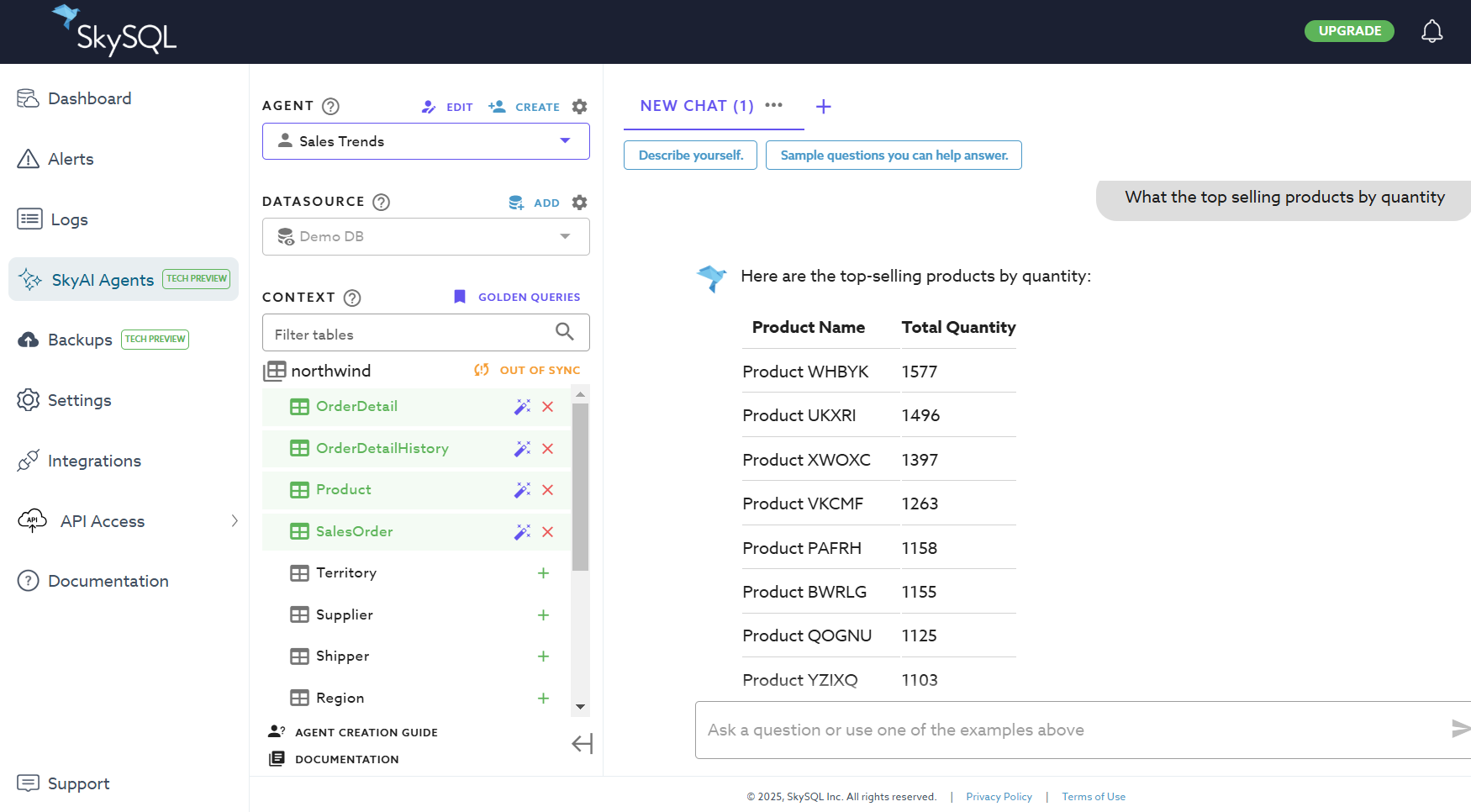
SkySQL is an AI-driven, serverless, fully managed Database-as-a-Service (DBaaS) designed for modern AI and SaaS workloads. With the no-code <strong>SkyAI Agent</strong> builder, developers can build agentic apps relying on DB-level agents for reliable natural language conversations with their operational data. These AI agents semi-autonomously build context to generate highly accurate and efficient SQL queries and utilize an evaluation process to score the responses.
SkySQL also provides built-in AI agents to improve developer and DBA productivity by assisting with SQL queries or stored procedure generation, database optimization, and performance analysis. This makes database management more efficient and accessible, as repetitive or complex tasks can be handled through conversational AI guidance.
Challenge: Accurate and Reliable Answers from Operational Data
Operational databases typically have intricate and messy schemas—hundreds of tables, cryptic column names, inconsistent foreign keys, and scattered data. Standard text-to-SQL methods, which rely solely on Large Language Models (LLMs), often return inaccurate or hallucinated results due to a lack of contextual schema awareness.
SkySQL faced several key challenges in enabling accurate answers on live, real-world operational data:
- Accuracy Issues: Complex queries across multiple tables frequently resulted in errors or unreliable results.
- Security and Data Governance: Balancing the need for detailed metadata and data samples with strict governance—ensuring only the relevant and necessary data reaches the LLM
- Complex State Management: Managing conversational context, changing metadata due to evolving schemas, and both short- and long-term memory to maintain continuity and accuracy across sessions.
- Significant Developer Effort: Designing an agent that can reason about schema, generate queries, and verify results is non-trivial and time-consuming without the right agent framework.
- Performance vs. Cost Trade-offs: Finding an optimal balance between query latency and LLM token usage is difficult.
Solution: Leveraging LlamaIndex for Agentic RAG Pipelines
To address these challenges, SkySQL adopted LlamaIndex as a central component in its AI agent architecture. LlamaIndex's framework provided powerful orchestration capabilities critical for accurate and efficient agentic RAG pipeline operations:
- Agentic Retrieval-Augmented Generation (RAG): Precisely supplies essential schema context to the LLM, significantly reducing query inaccuracies and hallucinations.
- <strong>SQL Table Retriever Query Engine</strong>: Translates the context plus the prompt into syntactically correct SQL.
- AgentRunner Workflow Control: Offers detailed control over LLM interactions, invoking LLM prompts only for genuinely complex questions, thus optimizing latency and token usage.
- Pluggable Vector Store Integration: Allows seamless integration of MariaDB as a vector database, eliminating the need for significant customizations to LlamaIndex.
Together, LlamaIndex’s orchestration and SkySQL’s schema awareness, vector indexing, and execution sandbox established a robust feedback loop, eliminating query response hallucinations.
Why LlamaIndex?
SkySQL evaluated several frameworks before adopting LlamaIndex. Key differentiators that drove their choice included:
- Superior Connectivity: Extensive integration options with relational databases, structured data sources, and external document repositories, providing flexibility for current and future needs.
- Advanced Agentic Capabilities: LlamaIndex enabled more nuanced, goal-oriented agent behaviors, essential for generating reliable and contextually accurate SQL queries.
- Rapid Implementation: Pre-built connectors, rich ecosystem, documentation, community examples, and streamlined integration significantly reduced development time, accelerating SkySQL's go-to-market timeline.
Results & Key Metrics
SkySQL’s integration of LlamaIndex delivered substantial benefits, including:
- Significantly Improved SQL Accuracy: The agentic RAG approach and structured query engine yielded precise and contextually correct SQL queries, dramatically reducing errors and ensuring reliable results.
- Enhanced Developer Productivity: Switching from ChromaDB to MariaDB vector storage was seamless, requiring minimal code changes due to LlamaIndex’s flexible design.
- Flexible AI Model Integration: SkySQL now easily integrates different LLMs, optimizing performance and providing the flexibility to use the best model for each use case.
Future Plans
SkySQL is actively working on advanced "online evaluation" strategies to maintain high accuracy and relevance, automating sophisticated DBA tasks through intelligent agents, and deepening integration with modern AI development environments using their MCP server (including Replit, Cursor.sh, and Windsurf).
Conclusion
Through the adoption of LlamaIndex, SkySQL has significantly transformed how databases can be queried and managed via natural language interfaces. By streamlining how natural language interfaces can be embedded in applications, SkySQL has made complex database AI agent solutions more accessible and scalable for developers.
“LlamaIndex has been a game-changer for us, accelerating our AI agent development efforts, embedding reliable conversational interfaces directly within applications, and providing a flexible and scalable agentic framework.” — Jags Ramnarayan, Chief Technology Officer and Co-Founder, SkySQL
进一步信息揣测
- SkySQL的AI代理并非完全自主:虽然宣传为“半自主”,实际仍需开发者介入调试和验证,尤其在复杂查询场景下,完全依赖可能导致错误结果。
- 真实数据库环境的复杂性被低估:文章提到“数百张表、混乱的外键”等,但未透露实际处理这类问题时,需额外定制化清洗和元数据管理工具,这些通常需付费或内部支持。
- 安全与性能的隐性成本:严格的数据治理(如限制LLM访问范围)可能增加架构复杂度,导致查询延迟上升,需权衡安全性与响应速度,这一平衡点通常需经验积累。
- LlamaIndex的集成并非无缝:尽管提到“无需大量定制”,但实际部署中,与MariaDB等向量数据库的适配可能需专业团队调试,尤其是处理高并发或超大规模数据时。
- 开发者隐性负担:虽然声称减少开发时间,但构建可靠的Agent框架(如状态管理、结果验证)仍需深厚经验,新手可能因低估复杂度而踩坑。
- LLM token开销的隐藏陷阱:优化token使用与查询性能的平衡需精细调参,公开文档很少提及具体策略,企业可能需购买高级支持服务获取最佳实践。
- 行业竞争内幕:类似SkySQL的DBaaS产品通常依赖第三方AI组件(如LlamaIndex),其核心差异化在于私有化部署的优化细节,但这些细节通常保密或需NDA协议才能获取。
- 实际案例的局限性:成功场景可能基于特定数据集或简化环境,而真实用户遇到的边缘情况(如动态变更模式)解决方案未公开,需通过客户支持或社区渠道挖掘。